
When property owners across Center City, Fairmount, and Graduate Hospital invest in repainting their homes, visual attention naturally focuses on selecting color palettes and sheen levels. However, interior paint is a thin, decorative surface coating; it possesses no structural filling properties and cannot conceal physical substrate defects. Applying premium paint over cracked plaster, dented drywall, or uneven patch repairs results in a compromised finish that magnifies every underlying flaw. Achieving a flawless, long-lasting aesthetic relies almost entirely on the rigorous surface preparation executed before a paint brush or roller ever touches the wall.
Why Paint Cannot Hide Substrate Imperfections
A common homeowner misconception is that applying multiple coats of high-build paint will fill hairline cracks and smooth over rough surface textures. In reality, liquid paint conforms precisely to the contours of the underlying surface. When dry, paint film measures only a few mils in thickness—roughly the depth of a sheet of notebook paper.
Rather than hiding defects, new paint frequently makes them more obvious. Modern interior acrylics—particularly eggshell, satin, and semi-gloss finishes—reflect light across the wall plane. When natural sunlight from large rowhome windows or illumination from recessed ceiling fixtures strikes an uneven wall, the reflected light casts shadows across every nail pop, settling crack, and rough drywall seam. A truly smooth visual finish requires mechanical surface leveling prior to coating application.
The Phases of Professional Wall Preparation
Professional interior painting requires a systematic preparation workflow to transition aging urban walls into a stable, uniform canvas:
- Surface Cleaning and Decontamination: Walls accumulate airborne dust, cooking greases, and atmospheric oils over time. Painting over contaminants prevents proper chemical adhesion, leading to premature peeling. Surfaces must be washed with specialized cleaning solutions and allowed to dry completely.
- Excavating and Patching Defects: Loose, flaking paint and crumbling plaster must be removed. Minor nail pops and shallow dents are filled with lightweight patching compounds, while recurring structural settlement cracks require widening, filling with setting-type joint compound, and reinforcing with fiberglass or paper mesh tape to prevent reopening.
- Mechanical Sanding and Feathering: Once patch compounds cure, they must be sanded flush with the surrounding wall. Professional painters feather the outer edges of patches so the transition between new repair material and existing drywall is undetectable to the touch.
Differentiating Patching from Skim Coating
While isolated patching resolves minor damage, historic Philadelphia rowhomes often feature walls with widespread surface irregularities, heavy brush marks from previous decades of painting, or damaged paper facing from removed wallpaper. In these scenarios, spot patching is insufficient.
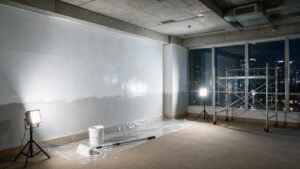
To restore a Level 5 glass-smooth surface across an entire room, technicians perform skim coating. Skim coating involves troweling a thin, uniform layer of diluted joint compound across the entire wall surface. Once cured and mechanically sanded with dust-extraction equipment, this comprehensive resurfacing eliminates decades of accumulated texture, providing a pristine substrate for modern paint application.
Priming, Flashing Prevention, and Site Protection
A critical technical step between wall repair and finish painting is the application of appropriate primers. Raw drywall joint compound is highly porous, whereas adjacent painted drywall is sealed. If topcoat paint is applied directly over an unprimed patch, the porous joint compound absorbs the liquid paint resin faster than the surrounding wall. This uneven absorption creates dull, matte patches known as “flashing” that remain visible even after multiple coats. Applying a high-quality PVA drywall primer or stain-blocking sealer unifies surface porosity and texture across the entire wall, ensuring uniform color depth and sheen development.
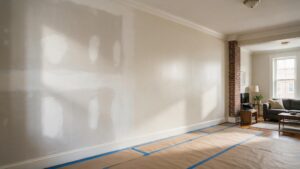
Throughout this preparatory process, protecting your property is paramount. High-end residential painting requires establishing clear work boundaries, deploying adhesive protection films over hardwood flooring, wrapping light fixtures, and draping furnishings in clean plastic sheeting. Because older urban properties constructed before 1978 may contain legacy lead-based coatings, adhering to EPA lead-safe renovation guidance during surface preparation is essential for preventing hazardous dust migration and protecting indoor air quality.
By relying on an experienced team for interior painting services in Philadelphia, your project benefits from meticulous surface engineering that transforms aging walls into immaculate interior spaces. Where extensive plaster damage or wallboard deterioration is present, our integrated professional drywall repair ensures your substrate is structurally solid before painting begins. Contact Philadelphia Painting Services today to schedule an expert interior surface evaluation.
Will applying a thicker coat of paint hide hairline cracks in my plaster walls? No. Paint is a thin surface film that conforms to the physical contours beneath it. Hairline cracks must be mechanically excavated, filled with flexible patching compound, and sanded smooth before painting to prevent them from remaining visible or reopening.
Why do repaired wall patches look duller than the rest of the painted wall? This visual defect is called flashing. It occurs when unprimed, porous patching compound absorbs the liquid resin from the finish paint faster than the surrounding sealed drywall. Applying a dedicated drywall primer over repairs prevents flashing.
What is the difference between standard drywall patching and skim coating? Standard patching addresses isolated surface defects like nail holes, dents, and minor cracks. Skim coating involves applying a thin, uniform layer of joint compound across an entire wall or ceiling to level widespread surface roughness and eliminate outdated textures.
Why must grease and atmospheric dust be cleaned off walls before repainting? Airborne dust, cooking greases, and oils act as a barrier between the old surface and new paint. If walls are not properly cleaned and degreased, new paint cannot achieve a secure chemical bond, which can lead to blistering and peeling over time.
How do professional painters protect furniture and flooring during extensive wall sanding? Professional contractors utilize heavy-duty drop cloths, self-adhesive floor protection films, and plastic furniture draping to seal the work environment. When mechanical sanding is required, vacuum-assisted dust-extraction sanders capture airborne particulates at the source.